


GLT
Why do custom glass bottles have high MOQ?
09-12-2026
High-volume production is the key to cost reduction.

In the custom glass packaging industry, many overseas clients often wonder: why can’t custom-shaped or specially crafted glass bottles be ordered in small batches like standard stock bottles? Why do they generally require MOQ in the tens of thousands?
Recently, many clients have inquired about custom glass bottles but have often postponed their orders due to concerns regarding mold fees, high MOQ, the high unit cost of small-batch customization, and inventory pressure.
In reality, high MOQ for custom glass bottles are not arbitrary barriers set by manufacturers to make cooperation more difficult; rather, they stem from the fundamental production logic and cost-optimization mechanisms of the glass industry. For frequently used custom glass containers-such as honey jars or food packaging bottles-a reasonable high MOQ is essentially a core strategy to help clients share overhead costs, ensure consistent product quality, and reduce long-term procurement expenses.
Today, using honey jar customization as a case study, we will delve into the underlying logic behind high MOQ for custom glass bottles and address key client concerns regarding prototyping, costs, and inventory.
- Dispelling Misconceptions: High MOQ Are Not Barriers to Entry, but an Industry Production Necessity
Many clients intuitively believe that higher MOQ lead to higher procurement costs and greater inventory pressure, so they naturally prefer small-batch customization and on-demand ordering. However, they often overlook the fact that glass bottles are industrial products created through high-temperature melt molding, requiring dedicated molds and large-scale assembly-line production. This process differs vastly from the flexible, small-batch production models used for injection-molded plastics or paper packaging, making low-cost custom production runs of only a few hundred or thousand units unfeasible.
First, consider the fixed costs associated with custom molds:
Custom-shaped honey jars require the creation of specific molds based on the client’s specifications for dimensions, curvature, texture, and neck finish. A set of high-precision glass bottle molds costs between several thousand and twenty thousand yuan. This cost covers multiple processes-including mold design, precision milling, heat treatment, and accuracy calibration-and represents a one-time fixed investment; the mold development cost remains constant regardless of whether the final production run yields 1,000 or 100,000 honey jars. For small-batch production, the mold costs allocated to each individual bottle skyrocket, directly causing the unit price to double.
Next is the issue of startup losses in the glass production line:
Glass bottle manufacturing relies on large-scale equipment such as high-temperature furnaces, fully automated forming machines, and annealing lehrs. Furnaces require continuous operation at high, stable temperatures; the processes of startup, heating, temperature adjustment, and shutdown all incur massive energy losses. Once a standard glass factory production line is activated, it requires continuous, stable operation for days or even weeks. Frequent changeovers for small orders or repeated shutdowns and restarts result in significant waste of electricity, gas, and labor, while drastically reducing production efficiency.
Furthermore, custom production entails hidden costs such as mold testing losses, process calibration, and quality inspection adjustments:
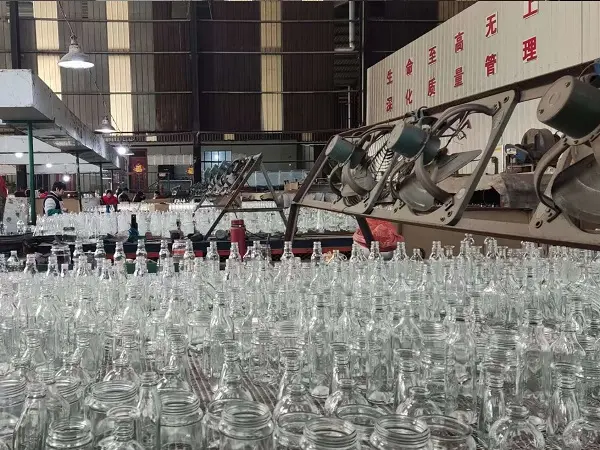
Putting a new mold into production for the first time requires multiple test runs and parameter adjustments. Defective or scrapped items resulting from these tests represent unavoidable losses; small-batch orders cannot absorb these costs, so they are ultimately passed on to the unit price of the product. This is the primary reason why the industry generally sets a MOQ of 30,000 units for custom glass bottles; for standard custom items like honey jars, an order volume in the tens of thousands represents the most cost-effective production range.
- Core Advantage: High MOQ Significantly Reduce the Total Procurement Cost Per Bottle
For clients engaged in long-term honey exports or brand retail, stocking large quantities may appear to tie up capital and increase inventory in the short term. However, when considering unit costs, long-term procurement, and product quality stability, high-volume custom orders offer far better value than small-batch trial runs and represent the optimal choice for scaling a brand.
- Amortizing fixed costs to drastically lower the unit price per bottle
The key cost difference in glass bottle customization lies in the allocation ratio of fixed costs. Taking custom honey jars as an example, the cost for a dedicated mold plus mold testing and calibration ranges from approximately 8,000 to 15,000 RMB. If only 3,000 honey jars are produced, the mold cost allocation alone amounts to 3-5 yuan per bottle; when raw material, energy, and labor costs are added, the unit price of the finished product remains high. Conversely, if the order volume increases to 30,000 units, the mold cost allocation drops to under 0.1 yuan per bottle, and the overall production cost per bottle decreases by 40%-50%-a significant reduction.
Furthermore, large-scale production allows factories to optimize raw material procurement, production scheduling, and logistics. Bulk purchasing of glass raw materials lowers unit costs, running production lines at full capacity maximizes energy efficiency, and shipping via sea or land significantly dilutes logistics costs. For honey exporters, this substantial drop in per-bottle cost directly boosts price competitiveness in overseas markets and significantly widens profit margins.
- Reducing process fluctuations and stabilizing the product yield rate

Glass molding demands precise control over temperature, pressure, molding speed, and annealing duration. When a new mold is first put into operation, equipment parameters require a stabilization and “break-in” period; early production runs often incur minor losses due to fine-tuning, resulting in a relatively lower yield rate. In contrast, during large-scale continuous production, equipment parameters stabilize, worker proficiency improves, and the production line operates at peak efficiency. Product dimensions, wall thickness, transparency, and the flatness of the bottle mouth become highly consistent, allowing the yield rate to stabilize at over 99%.
For food-grade packaging like honey jars, product consistency is crucial. Uniform bottle shapes and flat bottle mouths ensure a perfect fit with matching caps and sealing gaskets, preventing issues such as leakage or poor sealing and thereby preserving the honey’s shelf life. A high yield rate not only reduces losses from defective products but also avoids hidden costs associated with packaging mismatches and post-production rework-quality advantages that are unattainable with small-batch customization.
- Lowering long-term reorder costs and ensuring supply stability
Most honey brands operate on a long-term basis and require a stable supply of packaging. Frequent small-batch reorders necessitate repeated equipment adjustments, process calibrations, and startup losses, keeping the unit purchase price high. Additionally, different batches are prone to slight variations in color or dimensions, which can compromise the uniformity of the brand’s packaging. Placing a single, substantial custom order not only secures a lower ex-factory unit price but also allows the custom molds to be retained by the factory for long-term use; this eliminates the need to pay mold-opening fees for subsequent reorders, requiring payment only for production costs. Furthermore, consistent manufacturing processes and parameters ensure high uniformity across all product batches, allowing for seamless integration with your brand’s standardized packaging systems and significantly reducing the total costs associated with long-term procurement, quality control, and compatibility.
As a professional manufacturer, GLT Glass Bottles offers these insights based on extensive experience serving clients with custom glass bottle needs, as well as sincere advice for importers looking to commission custom glass packaging. Every enterprise has its own unique set of considerations; however, if cost reduction is a priority, we recommend working directly with a professional packaging solutions manufacturer like us. We can provide tailored packaging solutions designed specifically to meet your current requirements.