


GLT
Sample Confirmation Form: Ten places worth checking item by item before placing an order
10-31-2026
Over the years of doing glass bottle foreign trade, I have gradually come to understand a truth: drawings can be drawn in detail, emails can be written in length, but what really brings two companies together is actually the sample confirmation form signed by both parties. Don’t just treat it as a flow chart, its job is to translate verbal consensus into paper. The sample we sent out is the standard for this batch of goods. Production is directed towards it, and inspection is directed towards it. If there is a disagreement in the future, it will still be directed towards it. To dare to write this sentence in black and white to your supplier is to truly take responsibility for you.
On that list, there are ten places worth checking one by one before placing an order.

Capacity comes first because it is the beginning of all misunderstandings. For example, a 50ml glass bottle, does 50ml refer to the nominal capacity or the full capacity? Where is the loading line drawn? Three concepts should be written separately and not all squeezed into one “50ml”. If you ask the supplier to do a small thing, fill the bottle with water and place it on the scale before submitting the sample, take a weighing photo and send it over. The grams of water is the actual capacity, which is harder than any verbal guarantee.
The second one is the bottle mouth. Perfume bottles often use FEA standard crimped bottle mouths. 13 mm, 15 mm, 18 mm and 20 mm each have corresponding pump heads. The size is suitable or not. It can never be seen from the drawings. Only when you take the set of pump heads, aluminum sleeves and bottle caps that you really want to use and install them on the samples, and spin, pull off and seal them one by one, can it count. Ask the supplier to make a video of the assembly process and send it to you. After watching it, you can sign it. This way, it’s much cheaper than waiting until the goods are ready to be filled to find that they can’t fit?
The third one is size. The size should be written together with the tolerance, and do not write the isolated nominal value, as it has almost no reference value. Everyone knows that circular glass bottles have a tolerance range according to ISO 9058 standard. For example, a 150mm tall glass bottle can have a height fluctuation of about 1.2mm according to the formula. The algorithm takes one minute to calculate 0.6 plus 0.004 multiplied by 150. Small bottles such as perfume bottles and cosmetics bottles have another set of flaconage tolerance standards, covering the full mouth capacity, height, diameter and perpendicularity. What should appear on the confirmation form is the measured value with its tolerance zone, not a bare number.
The fourth one is weight. The distribution of glass material is hidden in the weight, and problems such as thick bottom and thin shoulders often show their weakness first from the fluctuation of weight. What is the standard weight and how much is the fluctuation? Only by writing it down in black and white can customers feel at ease.
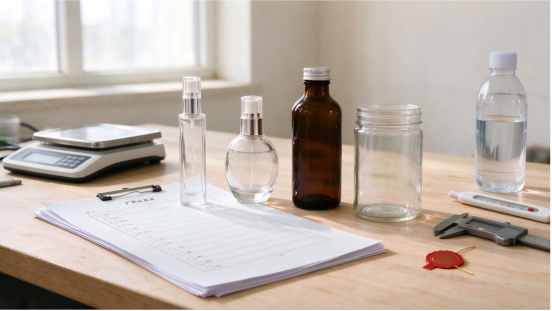
The fifth one is material color. The colors of glass bottles include white, high white, brown, green, and other colors. Remember to write down the acceptable color deviation range for customers in the order, so that if there are slight color differences between different batches, customers can still accept them.
6. The sixth is heat shock resistance. The old method is to soak the glass bottle in a hot water tank for a certain period of time before entering a cold water tank. Check the coarse glass bottle to see if there are no cracks or explosions, and it is qualified. If the bottle needs to be overheated during the filling or cleaning process, this item must be checked separately.
The seventh one is the appearance defect of the glass bottle. Like bubbles, stones, sutures, and cracks, they are classified into three levels: severe, major, and minor, and each level needs to specify the acceptable range for the customer. It would be better to attach a few more sample photos that can accept the location of the defect. When we arrive at the scene, photos are more effective than adjectives.
The eighth one is the coating. Generally, food cans and glass bottles need to be coated twice before leaving the factory. At the hot end, a layer of nanoscale tin or titanium oxide is attached in the form of vapor while the glass is still at a residual temperature of around 500 degrees Celsius. At the cold end, a layer of organic lubricant is sprayed at the exit of the annealing kiln. The combination of these two can effectively prevent scratches. Whether to apply coating and what state to accept should be confirmed with the customer in advance.
The ninth one is the adhesion of glass bottle decoration technology. The decoration process of glass bottles generally includes screen printing, hot stamping, spraying, sanding, grilling, relief carving, etc. The supplier is required to first take samples and perform adhesion inspection videos such as tape pasting and friction before finalizing the version. This confirmation pertains to the process itself, and only by doing so can we prevent rework bills from coming knocking on our door.
The tenth one is the sample seal and bottle bottom mold number. Both parties keep two signed sealed samples and then flip the bottle over to check the small number at the bottom. A production line often runs multiple sets of identical molds at the same time, each with its own number. Only the sample should indicate which mold number and cavity it comes from, so even if there are defects in the glass bottle after mass production, the factory can directly repair that mold without having to inspect the entire batch.
After these ten checks are completed, this order begins to work. The first thing to do in mass production is to check it, and the shipment inspection is to inspect it. When inspecting food with customers, holding the same piece of paper on both sides will increase efficiency. During the hour before placing the order, the trust of the customer is exchanged. The mold does not need to be repaired, the container does not need to be returned, and no one has to spend time guessing the other party’s intentions. This is also the reason why we always send this order together with the same product before placing an order.
Whether or not you ultimately place an order on GLT glass, it is recommended to take this form with you. It can not only help you avoid risks, but it can also be referred to as your glass bottle supplier. Only those who are willing to accompany you to complete the ten checks can be considered qualified suppliers who dare to take responsibility. For more questions about glass bottles, please feel free to ask GLT glass bottles at any time.