

GLT
How to Plan Your First Bulk Order of Mini Liquor Bottles: A Step-by-Step Guide for Beverage Brands
05-16-2026
How to Plan Your First Bulk Order of Mini Liquor Bottles: A Step-by-Step Guide for Beverage Brands
Ordering Mini Liquor Bottles Bulk for the first time can get complicated quickly. Start by choosing between filled 50ml liquor bottles and empty mini glass bottles. That decision shapes licensing, supplier options, shipping requirements, labeling, cost, and timelines. This guide walks you through the buying process, starting with requirements, state buying paths, and landed cost. From there, you’ll match suppliers to your use case, set procurement workflows, finalize packaging, inspect delivery, and plan smarter reorders. Use it to avoid delays and keep your first order moving.
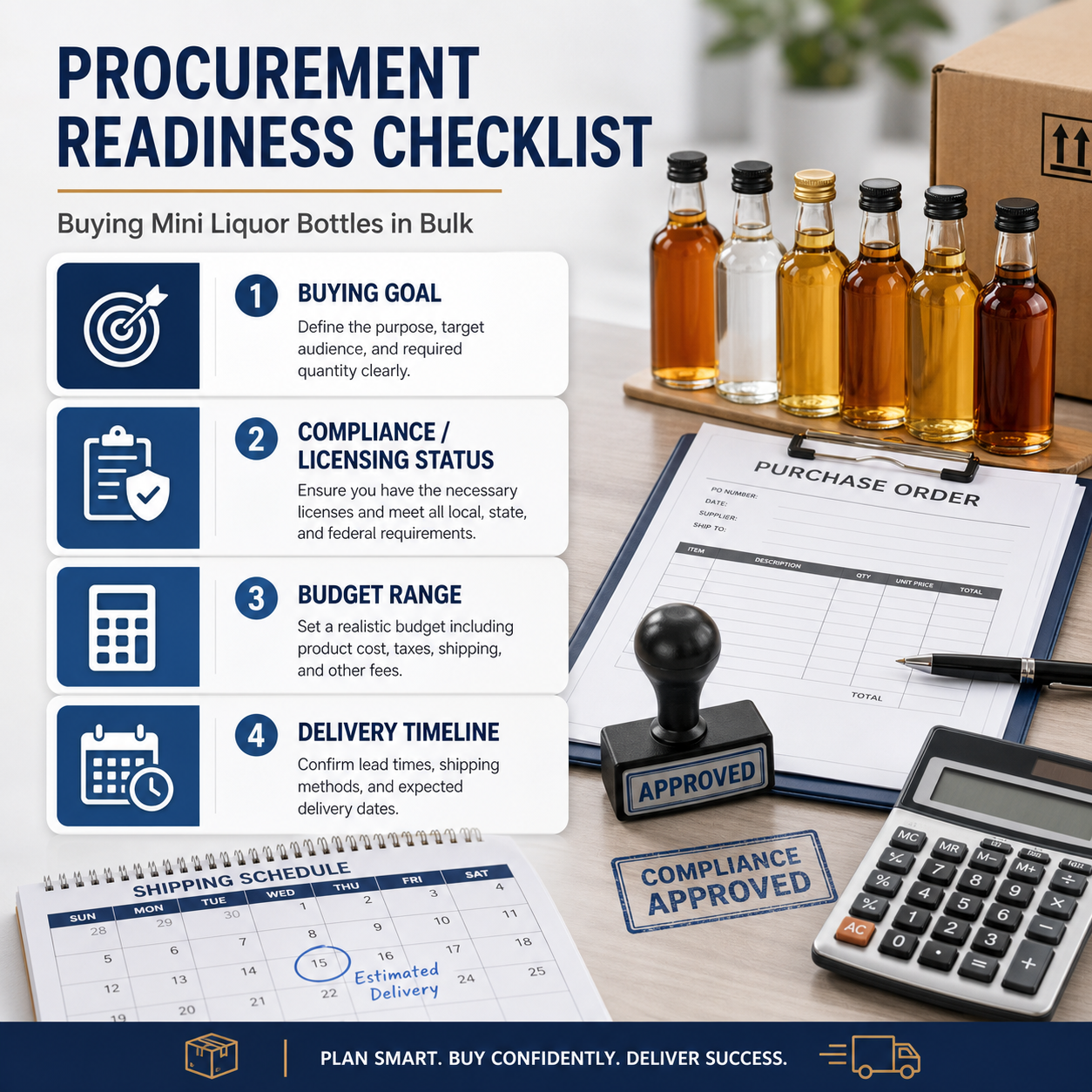
Prerequisites: Confirm Your Buying Goal, Compliance Status, Budget, and Timeline
Prerequisites: Confirm Your Buying Goal, Compliance Status, Budget, and Timeline
Before searching for the cheapest Mini Liquor Bottles Bulk quote, calculate the cheapest legal landed case. Include bottle price, case pack, freight, taxes, deposits, distributor markup, MOQ, breakage allowance, and state limits. This figure gives you a fair basis for comparing suppliers. It also helps you avoid low unit prices that turn costly after shipping, compliance, or repacking.
Use this four-step check before requesting quotes:
-
Define what you are buying.
Choose one category first: filled 50ml liquor bottles, empty 50ml glass bottles, or custom-branded miniature bottles. Each follows a different supply chain. Filled minis may require alcohol licensing, state-approved distribution, age verification, and compliant labeling. Empty glass bottles are packaging components. For accurate quotes, list the product type, bottle size, material, cap type, and whether alcohol is included. If you need filled bottles, include the alcohol type. -
Confirm your compliance path.
Your sourcing route depends on the product and delivery state. Some buyers can order through retailers. Others must buy through licensed distributors or control-state channels. A hotel minibar buyer, for example, may need a licensed wholesaler. An event agency buying empty glass minis can usually contact a packaging supplier directly. -
Set a landed-cost target.
Compare delivered cost, not bottle price alone. A $0.65 empty bottle quote and a $3.25 filled mini quote cover different products and cost structures. Include freight, taxes, deposits, labeling, storage, repacking labor, and breakage allowance. A 120-bottle case with high freight can cost more per delivered bottle than a higher unit-price case shipped locally. -
Lock the timeline.
Confirm your deadline before contacting suppliers. Stock bottles may ship quickly. Custom decoration, cartons, and caps add lead time. A clear timeline helps suppliers recommend available inventory, realistic packaging options, and the right fulfillment path.
Use this brief when contacting suppliers:
Mini Liquor Bottle Bulk Procurement Brief
Use case:
Quantity:
Delivery state:
License status:
Filled or empty:
Bottle size/material:
Alcohol type, if applicable:
Cap type:
Packaging needs:
Resale, gifting, sampling, or internal use:
Deadline:
Target landed cost per bottle:
Common mistakes include asking alcohol retailers for empty bottles, assuming online liquor sellers ship 50ml cases nationwide, and budgeting only on unit price. Set a target landed cost per bottle first. Then compare suppliers against the same buying goal, compliance path, and delivery timeline.
Step 1 – Choose Between Filled Mini Liquor Bottles and Empty 50ml Glass Bottles
Step 1 – Choose Between Filled Mini Liquor Bottles and Empty 50ml Glass Bottles
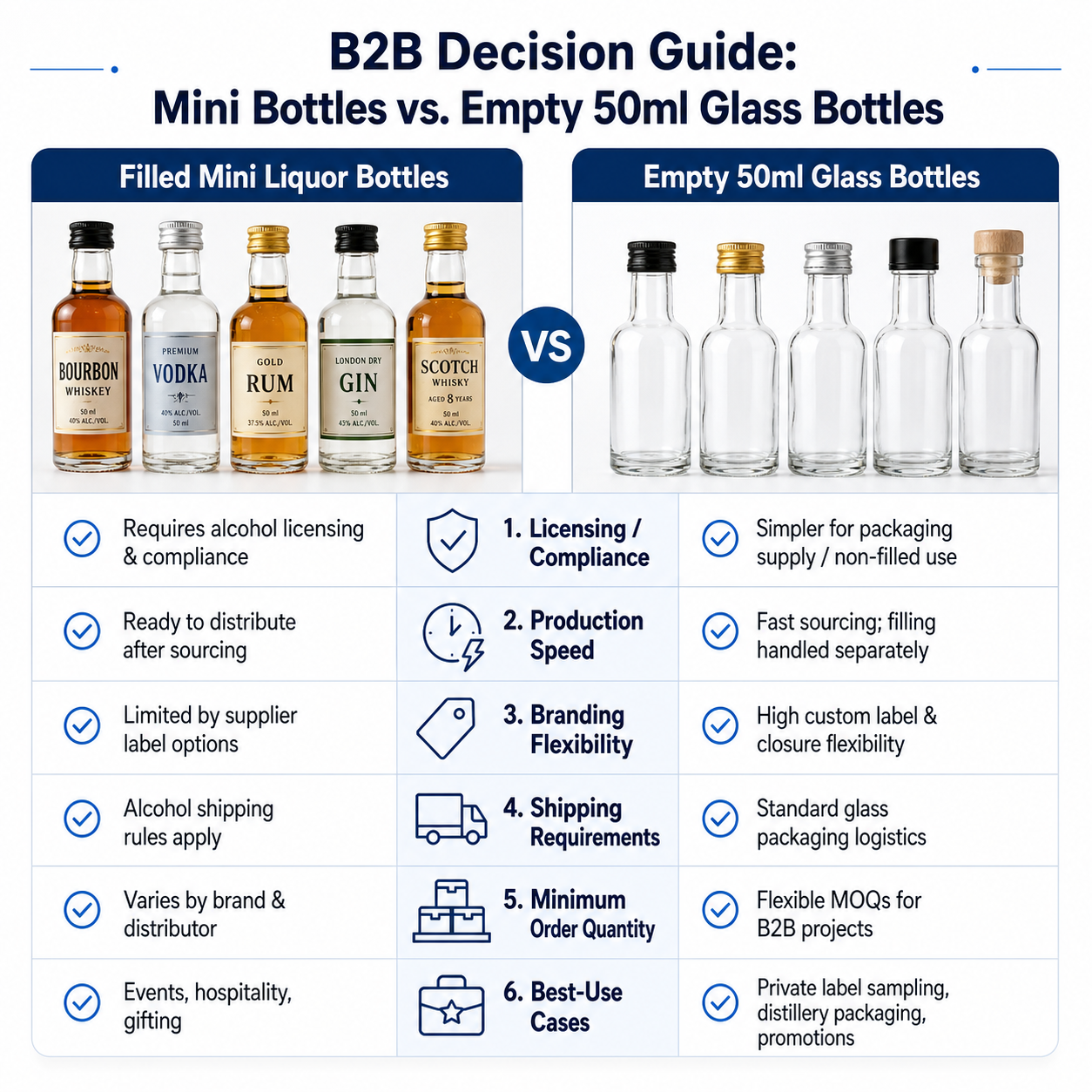
You may not need filled mini liquor bottles. For gifting, sampling, hospitality kits, or private-label packaging, empty 50ml bottles may be the smarter bulk sourcing path.
Before comparing bottle shapes, choose the procurement model. Buyers searching for Mini Liquor Bottles Bulk often compare alcohol, packaging, and compliance-controlled products as if they were the same item. They are not. Start by matching the product path to your use case:
- Buy filled mini liquor bottles for sealed alcohol from known brands, including resale, minibar use, airline service, bar inventory, and licensed retail.
- Buy empty 50ml glass bottles for non-alcoholic drinks, extracts, bitters, cosmetics, wellness products, sauces, and branded gift kits.
- Use empty bottles plus a licensed filler for private-label alcohol samples, wedding favors, corporate gifts, and subscription boxes with alcohol.
Compliance is the key difference. A filled 50ml liquor bottle is an alcohol product, not packaging. It may require licensed purchasing, approved distribution channels, state-specific rules, age verification, alcohol taxes, and shipping controls. An empty 50ml glass bottle is packaging, so sourcing shifts to caps, labels, cartons, tamper seals, and filling partners. For gifting or sampling, empty bottles with a compliant third-party filler can offer more branding flexibility than pre-filled national-brand minis.
Filled Mini Liquor Bottles vs Empty Mini Glass Bottles
Run a quick cost test before requesting quotes. If you need 2,000 branded units, a filled national-brand mini may look cheaper per bottle. That advantage can disappear once you add custom caps, labels, or gift-box packaging. A $0.25 change in packaging cost adds $500 per 2,000 units, before freight or labor.
Choose the compliant path before buying inventory. Filling empty bottles with alcohol and distributing them commercially without permits can create legal, fulfillment, and cost problems. Commercial alcohol distribution may also require formula approvals, label compliance, taxes, and state-specific approval.
Next action: define your use case in one sentence: “We need 50ml minis for resale,” “We need branded alcohol gifting,” or “We need non-alcoholic/private-label packaging.” Then request quotes from the right supplier type: alcohol distributor, bottle manufacturer, or licensed co-packer.
Plan 30-60 minutes for this step. It can save days of quoting the wrong vendors.
Step 2 – Map Your State Buying Path Before Comparing Bulk Suppliers
Step 2 – Map Your State Buying Path Before Comparing Bulk Suppliers
Before you compare prices for Mini Liquor Bottles Bulk, map the legal buying path for your delivery state. A bulk mini liquor bottle vendor may serve one buyer but be unable to fulfill the same 50ml spirits order in another state. Alcohol moves under state-specific rules. In the U.S., filled spirits usually pass through the three-tier system: producer/importer → distributor/wholesaler → retailer. The National Alcohol Beverage Control Association identifies 17 control jurisdictions where the state controls spirits sales in some form. For buyers, that can shift a simple online order into a distributor quote, a state store order, or a rejected shipment.
Start with a quick State Buying Path Matrix before supplier outreach:
Use this three-step check before you contact suppliers:
-
Confirm the product type. Filled 50ml alcohol minis trigger alcohol rules. Empty mini glass bottles usually fall under packaging, food-contact, closure, labeling, and product-use requirements.
-
Check your state alcohol beverage control agency. Search “[state] alcohol beverage control spirits shipping” and “[state] wholesale liquor license.” A 30-60 minute check can prevent days of back-and-forth with suppliers that cannot legally ship.
-
Ask the vendor one filter question: “Are you licensed or authorized to sell 50ml spirits into my state for my intended use?” A clear answer separates eligible suppliers from vendors that cannot fulfill the order.
Treat a national ecommerce “buy online” button as a starting point, not proof of eligibility. The page may show inventory, but inventory does not confirm legal shipment of bulk spirits to your address. Some buyers compare unit price first and plan to solve compliance later. That approach can work for empty glass minis. For filled spirits, compliance defines the supplier pool, minimums, lead time, taxes, and whether the quote is usable.
Step 3 – Calculate the True Landed Cost Per Mini Bottle
Step 3 – Calculate the True Landed Cost Per Mini Bottle
Before choosing a supplier, build a simple landed cost spreadsheet. Compare the total delivered cost per usable mini bottle, not the advertised 50ml unit price. For most Mini Liquor Bottles Bulk orders, this takes 30-60 minutes. Orders with custom packaging, multi-state delivery, or mixed-brand assortments may need more review. The goal is to compare suppliers on the cost you can act on: what you pay for bottles that arrive intact, meet requirements, and can be used or resold.
Include these inputs in your calculator:
- Product costs: bottle price, case quantity, order quantity, supplier MOQ, brand mix, and case pack size.
- Delivery and handling costs: freight, fuel surcharge, pallet fees, liftgate fees, residential fees, breakage allowance, and repacking labor.
- Compliance and packaging costs: sales tax, excise tax where applicable, bottle deposits, import duties for empty bottles, age-verification costs, labels, cartons, inserts, and state-specific shipping limits.
After you total the delivered cost, divide it by the number of usable bottles received. That final number gives you the real supplier comparison. For example, Supplier A quotes $1.95 per filled mini. The order requires 600 bottles, adds $420 in freight, and ships glass cross-country. Supplier B quotes $2.15 with freight included and stronger case packaging. If Supplier A has 2% breakage, its usable cost may exceed Supplier B’s. The lower listed unit price may not be the better buy.
Case packs can also distort the math. A 120-bottle case, 60-bottle case, and 100-bottle event pack may create different overbuy levels, storage needs, and leftover inventory. Compare suppliers by the quantity you can actually use, not the neatest price on the quote. This is especially useful when your order includes several brands or package formats. A slightly higher unit cost may still win if it reduces leftovers, simplifies storage, or arrives in packaging that protects the product.
Apply the calculator by use case:
-
Hotel minibar order: A 500-room hotel may buy 1,000-3,000 minis across vodka, whiskey, tequila, and liqueurs. Margin matters because each bottle becomes resale inventory. Premium brands may justify a higher landed cost if the minibar price supports it. Compliance risk sits with licensed purchasing, distributor rules, and local alcohol control requirements.
-
Event planner order: A planner buying 800 minis for welcome bags needs deadline certainty, not just the lowest price. Packaging costs may include gift cartons, inserts, branded labels, and labor to pack each bag. Add a 1-3% shrinkage allowance for broken glass, venue changes, and last-minute guest count increases.
-
Corporate gifting order: A gifting team may need 250 premium minis shipped with glassware or snack kits. Pre-filled mini liquor bottles create more legal risk than empty mini bottles because alcohol shipment rules vary by state. Empty 50ml glass bottles may be the better route if the recipient company fills locally through a licensed partner.
Pro tip: create two spreadsheet tabs: pre-filled minis and empty mini bottles. Pre-filled bottles simplify sourcing when your license and state allow them. Empty bottles give you more control over branding, inserts, and fulfillment. They also add filling, sealing, labeling, and compliance steps. Keeping the two tabs separate prevents an unfair comparison between a ready-to-use product and a packaging component that still needs labor, materials, and approvals.
Step 4 – Match Bulk Sourcing Options to Your Use Case
Step 4 – Match Bulk Sourcing Options to Your Use Case
Choose your sourcing path by use case, not by the lowest bottle price. A 50ml mini for a hotel minibar, wedding favor, or private-label tasting kit can require different suppliers, labels, case packs, approvals, and delivery controls. For that reason, Mini Liquor Bottles Bulk sourcing should start with specifications, not quotes.
Set aside 45-90 minutes to build a supplier requirement list before you contact vendors. If your program involves multi-state gifting, airline catering, or subscription alcohol delivery, schedule legal review before requesting pricing.
What to do: define how the bottles will be used, then match that use case to the right supplier channel.
Why it matters: bulk mini liquor bottles are now a packaging, compliance, and brand-experience decision, not only a spirits purchase. Demand is shaped by premium gifting, hotel minibar resets, event personalization, airline and hospitality recovery, sustainability pressure, and private-label sampling. These programs often need 50ml glass bottles, mixed cases, custom labels, or recyclable packaging. NABCA identifies 17 U.S. control jurisdictions, while many other states restrict direct alcohol shipping in different ways. A supplier that works for a Nevada event may fail for a corporate gift campaign shipping to Pennsylvania, Utah, and North Carolina.
How to do it: write a one-page supplier brief before asking for pricing. Include three items:
- Product format: filled 50ml bottles, empty 50ml glass bottles, or both.
- Branding needs: national brands, mixed cases, custom labels, neck tags, and gift boxes.
- Fulfillment rules: delivery state, delivery date, storage, age verification, and resale status.
Next, build your pricing check around one tradeoff: assortment packs save planning time but often raise unit cost. Use them when variety matters more than margin, such as weddings, influencer mailers, and VIP event bags. If assortment pricing runs more than 10-15% above single-SKU case pricing, compare single-SKU cases with separate kitting before you buy.
Pre-filled minis can simplify sourcing when licensed channels support your use case. Empty 50ml glass bottles may work better for private-label sampling, non-alcoholic spirits, cocktail kits, and markets where shipping filled alcohol creates friction. Empty bottles also give your team more control over closures, labels, recyclable packaging, and future product tests.
For commercial programs, confirm resale rights, storage rules, shipping limits, labeling, and invoice requirements before buying consumer mini bottle packs. A wedding planner may only need legal event service. A liquor store needs legal resale inventory. A subscription box needs repeatable sourcing and compliant delivery.
Before you contact suppliers, choose your next action. Request filled mini bottle quotes from licensed alcohol channels, request empty 50ml glass bottle quotes from packaging suppliers, or ask for a hybrid program with kitting, labeling, and compliance support.
Step 5 – Vet Suppliers: Retailers, Distributors, Manufacturers, and Packaging Partners
Step 5 – Vet Suppliers: Retailers, Distributors, Manufacturers, and Packaging Partners
Build your shortlist by supplier type, not by the lowest listed price. For Mini Liquor Bottles Bulk orders, the right vendor could be a licensed alcohol distributor, state-approved retailer, glass bottle manufacturer, packaging decorator, or contract filler. The best fit depends on what you need to buy, where it must ship, and whether the supplier can handle repeat B2B orders.
Plan on 2-5 business days to vet suppliers for filled mini bottles. Allow 1-2 weeks for empty 50ml glass bottles that need custom labels, closures, or filling. Custom glass molds, imported inventory, and decorated packaging can take longer, especially if multiple vendors are involved.
What to do: split your shortlist into three tracks before requesting quotes.
- Filled mini liquor bottles: licensed retailers, local distributors, brand reps, state-approved channels, and specialty beverage wholesalers.
- Empty 50ml bottles: glass bottle manufacturers, packaging distributors, importers, closure suppliers, decorators, and contract fillers.
- Hybrid programs: empty bottles plus filling, labeling, kitting, and compliance support for gifting, events, sampling, or hospitality.
This structure keeps the buying process practical. A supplier that sells filled minis may be unable to decorate glass. A bottle manufacturer may offer strong pricing but no filling support. A contract filler may require you to source bottles, closures, and labels separately. Sorting suppliers by role helps you avoid mismatched quotes and wasted outreach.
Why it matters: bulk sourcing breaks down when buyers contact vendors that cannot legally sell into the delivery state. It also fails when suppliers cannot support commercial order requirements. The U.S. alcohol system still depends on state rules and approved channels. NABCA identifies 17 control jurisdictions, which can affect how spirits move into commercial accounts. A supplier with a strong online listing may still lack the license, invoice format, age-verification process, or distributor access your order requires.
For example, a hotel group refreshing minibars in three states may need three sourcing paths. One state may require distributor-supplied filled 50ml bottles. Another may require a control-state route. A third may need empty branded bottles for welcome kits. One “bulk mini bottle” vendor rarely solves all three needs.
How to vet each supplier: request the same facts from every candidate. Ask for business references, lead times, case pack details, stock availability, certificates, sample policies, and damage claim procedures. Then compare suppliers with a consistent scorecard.
Use a quantified cutoff when bids are close. If two suppliers differ by less than 5-8% landed cost, choose the one with stronger license coverage, faster claims handling, and more reliable repeat inventory access.
Marketplace listings may look faster, but they often create problems for B2B buyers. Amazon-style sellers may be unable to provide commercial invoices, compliance documents, bulk case consistency, or repeat stock guarantees. That risk grows when minis shift from a simple spirits purchase into a packaging, compliance, and brand-experience decision.
Demand is already moving in that direction. Premium corporate gifting needs cleaner presentation. Hotels are resetting minibars and welcome kits. Events want personalization. Airlines and hospitality buyers are rebuilding single-serve programs. Private-label sampling needs filled or fill-ready 50ml glass. Sustainability pressure also favors recyclable glass, right-sized cases, and fewer repacks.
Pro tip: order samples before placing the full PO. Test bottle height, label panel, cap fit, closure torque, carton strength, and breakage rate. A cheap 50ml bottle becomes expensive when the cap leaks, the label wrinkles, or the case fails in freight.
Step 6 – Set Up Distributor Accounts and Procurement Workflows
Step 6 – Set Up Distributor Accounts and Procurement Workflows
If you need filled 50ml alcohol minis for resale, hospitality, corporate gifting, or another regulated use, open the correct distributor or wholesale purchasing account before you shop by brand. B2B buyers searching for Mini Liquor Bottles Bulk often land on consumer retail sites first. Those channels rarely support regulated procurement. Licensed distributors provide legal invoicing, repeat ordering, credit terms, and state-specific SKU availability. Allow 2-10 business days to open an account when your documents are ready. Control states and special orders may take longer. The National Alcohol Beverage Control Association identifies 17 control jurisdictions, so your buying path may run through a state system.
What to gather before contacting distributors:
- Business license, liquor license, resale permit, and tax ID
- Payment references, billing details, and delivery address
- Authorized buyer list, expected case volume, and order frequency
With your documents in place, contact local distributors or brand reps and request five details: 50ml SKU availability, catalog access, price sheets, delivery schedules, and MOQ rules. Next, confirm credit terms, substitution policies, split-case rules, seasonal inventory, and special-order procedures. These details shape your true unit cost. For example, if a distributor sells full cases of 120 bottles and your event needs 300 units, your actual order becomes 360 bottles. Build that overage into your landed cost before you compare suppliers or approve a purchase order.
Availability can also vary by brand, size, and state. A whiskey brand may sell 750ml bottles in your market but offer no 50ml SKU through that distributor. When that happens, choose a sourcing path early. You can switch brands, use mixed cases, or buy empty 50ml glass bottles for a compliant private-fill or non-alcohol packaging program where allowed. Early decisions prevent rushed substitutions and keep legal, purchasing, and operations aligned.
For your article visual, include a “Distributor Account Setup Checklist” with required documents, contact owner, approval status, and typical timeline. Procurement teams can use it as a handoff tool between operations, legal, and purchasing. If multiple departments approve vendors, add fields for catalog access, credit approval, delivery schedule, and special-order notes. That structure helps the next buyer reorder without rebuilding the process.
Pro tip: if your brand requirements are flexible, ask about discontinued, seasonal, or promotional 50ml inventory. These options can reduce unit cost for events, samplers, and welcome kits. Looking ahead, bulk mini liquor bottles are becoming a packaging, compliance, and brand-experience decision, not just a spirits purchase. Hotel minibar resets, airline and hospitality recovery, premium gifting, event personalization, custom labels, sustainability pressure, recyclable packaging, and private-label sampling all affect what “best supplier” means. Choose vendors that can support filled minis today, mixed cases next quarter, and custom 50ml glass packaging as your program grows.
Step 7 – Specify Packaging, Branding, Labels, and Compliance Requirements
Step 7 – Specify Packaging, Branding, Labels, and Compliance Requirements
Finalize the packaging spec before placing a bulk order. For Mini Liquor Bottles Bulk orders, packaging affects presentation, compliance, shipping, and brand experience. These bottles may appear in hotel rooms, gift boxes, airline carts, event bags, and retail displays. Poor labels, mismatched caps, leaking closures, or non-compliant alcohol messaging can damage trust and create legal risk. Demand is also shifting. Premium gifting, minibar resets, event personalization, hospitality recovery, sustainability requirements, and private-label sampling are increasing the need for 50ml glass bottles, mixed cases, custom labels, and recyclable cartons.
Use this checklist to brief suppliers, compare quotes, and avoid rework.
-
Define the bottle path
- What: Decide whether you are buying filled minis or empty 50ml glass bottles.
- Why: Filled bottles come with alcohol labeling, tax, distribution, and shipping restrictions. Empty bottles give you more control over branding. They also require a licensed producer, co-packer, or compliance expert if alcohol goes inside.
- How: For filled minis, confirm which supplier labels, seals, tax stamps, health warnings, and product identity details must remain visible. For empty bottles, specify glass color, shape, finish, neck size, cap type, cap liner, and tamper-evident band.
-
Lock the label and decoration rules
- What: Confirm label dimensions, barcode placement, gift tags, sleeves, cartons, and inserts.
- Why: A curved 50ml bottle leaves limited label space. A design made for a 750ml bottle may wrinkle, peel, or cover required product information on a mini.
- How: Request a dieline or bottle drawing with the label panel marked. Before approving the full run, test label adhesion under cold storage, condensation, handling, and shipping vibration.
-
Specify outer packaging
- What: Choose carton style, divider inserts, case count, pallet quantity, and recyclable materials.
- Why: Breakage and repacking can erase a low unit price. A cheaper carton may cost more if it increases damage or slows fulfillment.
- How: Ask for a packaging specification sheet showing the bottle drawing, cap type, label area, bottles per carton, cartons per pallet, and pallet height.
For example, a corporate gifting buyer ordering 2,400 filled minis should confirm whether decorative neck tags are allowed. The buyer should also verify whether branded gift boxes are permitted and whether the carrier requires adult-signature delivery.
Common mistake: covering required alcohol labels, health warnings, tax stamps, or product identity information with decorative stickers.
Plan 2-5 business days for a standard packaging review. Allow 2-4 weeks for custom labels, cartons, compliance review, and production samples.
Step 8 – Place the Order, Inspect Delivery, and Track Post-Purchase Performance
Step 8 – Place the Order, Inspect Delivery, and Track Post-Purchase Performance
Place the order only after the quote has been converted into a detailed purchase order. For Mini Liquor Bottles Bulk orders, the PO is your control document for pricing, freight, packaging, compliance paperwork, and delivery claims. It should list the SKU, bottle size, case pack, total quantity, unit price, delivery address, freight terms, delivery window, required documents, and packaging specs. Example: “50ml clear glass round bottle, black screw cap, 240 bottles per case, 10 cases, custom label applied, recyclable corrugated cartons, delivery by June 10.” This detail helps prevent correct bottles from arriving in the wrong pack, or full cases arriving without caps.
The final handoff is where many bulk mini bottle orders lose value. A low quote means little when bottles arrive broken, labels are misaligned, SKUs are wrong, caps are missing, or freight arrives after an event load-in. Use a simple decision rule: if landed cost savings are under 5%, choose the supplier with stronger on-time delivery, lower breakage history, and clearer claims handling. The cheapest supplier can become the most expensive if receiving problems create rework, rush replacements, or unusable inventory.
How to receive the order:
- Before signing freight paperwork: Inspect visible carton damage. Note “subject to inspection” or record damage on the delivery receipt. Check for crushed, wet, or leaking cartons before signing.
- During receiving: Count cases, photograph pallets, open sample cartons, check seals, verify labels, and confirm caps or closures.
- Within 24 hours: Document shortages, breakage, wrong SKUs, or label defects. Send photos, the PO number, carton count, and requested remedy.
For smoother claims, build a receiving checklist into your internal process. The checklist should prompt staff to photograph pallet condition, carton labels, damaged bottles, seal issues, and any mismatch against the PO. Add a damage claim email template with fields for PO number, delivery date, carrier, affected cartons, photo attachments, and requested resolution. This keeps receiving teams consistent. It also gives suppliers the details they need to replace, credit, or investigate the issue quickly.
After delivery, create a supplier scorecard. Track landed cost per usable bottle, breakage rate, on-time delivery, claim response time, and reorder accuracy. Repeat buyers should build approved supplier records from actual performance, not quote promises. This is more strategic as hotels reset minibars, gifting teams request premium 50ml glass, events add personalization, and private-label sampling requires reliable custom packs. Sustainability pressure also favors recyclable cartons, right-sized cases, and fewer reships. Bulk mini liquor bottles are now a packaging, compliance, and brand-experience decision-not just a spirits purchase.
Real-World Mini Liquor Bottle Bulk Challenges and Solutions
Real-World Mini Liquor Bottle Bulk Challenges and Solutions
The fastest fix is to stop treating every sourcing problem as a vendor problem. For Mini Liquor Bottles Bulk projects, diagnose the blocker first: legal channel, landed cost, supplier fit, or packaging lead time. Once you know the constraint, match it to the right corrective action.
Run this troubleshooting pass before sending another RFQ. It takes about 30-45 minutes and can prevent days of dead-end outreach. Most failed searches do not need more vendors. They need a clearer sourcing brief, accurate compliance details, and a realistic volume forecast.
1. If the issue is legality, fix the channel.
Confirm whether filled minis can move through retail, wholesale, or state-approved channels for your destination. The National Alcohol Beverage Control Association identifies 17 control jurisdictions, and alcohol rules vary by state. A supplier that can ship 50ml whiskey minis to one buyer may legally reject another. Before requesting pricing, ask: “Can you ship filled 50ml spirits to [state] for [business use] under [license status]?” If the answer is no, move to a distributor or approved in-state channel.
2. If the issue is price, compare formats.
Many buyers start by chasing the lowest mini bottle price. For private-label sampling, non-alcoholic gifting, or compliant contract filling, empty 50ml glass bottles may be the better path. Use a clear decision rule: if decoration, freight, and alcohol compliance add more than 15-25% to the filled mini quote, price an empty-bottle option. Compare both formats by landed cost per usable bottle, not by shelf price.
3. If the issue is timing, split the project.
Different use cases need different supply paths. A hotel minibar reset may require sealed branded spirits, while an event sponsor may only need custom-labeled bottles in gift kits. Premium gifting, airline and hospitality recovery, event personalization, sustainability pressure, and private-label sampling are pushing bulk minis beyond simple alcohol purchasing. To protect the launch date, separate bottle procurement from decoration, kitting, and fulfillment.
Pro tip: keep two supplier paths active when possible: one for regulated filled minis, and one for empty bottles, recyclable packaging, or non-alcoholic alternatives. Bulk mini liquor bottles are now a packaging, compliance, and brand-experience decision, not just a spirits purchase.
Advanced Tips for Lower Cost, Better Compliance, and Scalable Procurement
Advanced Tips for Lower Cost, Better Compliance, and Scalable Procurement
After your first successful order, move from “buying minis” to managing a repeatable 50ml bottle program. For Mini Liquor Bottles Bulk procurement, each reorder should support a larger sourcing plan. The goal is straightforward: fewer SKUs, cleaner compliance, stronger landed cost, and suppliers that can scale beyond the next case. The sequence below turns a working purchase into a stronger procurement model.
-
Consolidate your SKU list
What: Reduce slow-moving brands, bottle shapes, caps, and label versions.
Why: Each variation adds picking work, storage needs, compliance review, and replenishment risk. A hotel minibar reset, for example, may perform better with three proven 50ml spirits and one standard cap spec. Eight mixed minis from different suppliers can create avoidable complexity.
How: Review 60-90 days of usage. Keep the SKUs that move, standardize bottle and cap specs where possible, and negotiate around repeat volume. -
Negotiate total program value, not only unit price
What: Ask for case pricing, pallet pricing, forecast-based holds, or flexible delivery windows.
Why: Suppliers may hold firm on bottle price but improve the total program through freight, warehousing, mixed-case handling, or payment terms.
How: Share a quarterly forecast with low, expected, and high-volume scenarios. For filled alcohol minis, align orders with distributor delivery cycles. For empty glass bottles, discuss higher-volume manufacturing after demand is proven. -
Build compliance into the buying calendar
What: Pre-approve labels, ship-to states, age-verification steps, and resale documentation before peak season.
Why: The U.S. alcohol system is fragmented. NABCA identifies 17 control jurisdictions, and rules can vary by product, buyer type, and delivery location.
How: Maintain a state-by-state approval sheet for filled minis. Use a separate packaging spec sheet for empty 50ml glass bottles. Include bottle, cap, label, and decoration requirements.
This sourcing discipline matters because demand is shifting. Bulk mini liquor bottles now involve packaging, compliance, and brand experience-not just spirits purchasing. Premium gifting, event personalization, hotel minibar resets, airline and hospitality recovery, private-label sampling, and recyclable packaging are shaping buyer expectations. As a result, buyers are looking more closely at 50ml glass quality, mixed cases, custom labels, and decorated packaging. Quarterly forecasting helps teams plan stock, branding, and supplier selection before peak purchasing periods arrive.
Scale in stages. Validate repeat demand before committing to custom molds, imported containers, or large inventory positions. Overseas sourcing can lower unit cost, but freight timing, breakage, MOQs, and compliance delays can erase the savings. For empty glass bottles, consider private molds, decorated glass, and overseas production only after your reorder pattern is clear.
Suggested roadmap visual: Bulk Mini Bottle Optimization Roadmap – first order → repeat order → quarterly forecast → custom packaging → strategic supplier agreement.
FAQ: Bulk Mini Liquor Bottles for B2B Buyers
FAQ: Bulk Mini Liquor Bottles for B2B Buyers
Use this Mini Liquor Bottles Bulk FAQ to clear final buying questions before you request quotes. Start with the factors that shape price, availability, and supplier fit: legal buying path, filled versus empty bottles, landed cost, MOQ, packaging, and delivery limits. Before outreach, prepare your specs so suppliers can quote accurately.
1. Can I buy 50ml liquor bottles in bulk online?
Sometimes. Your buying path depends on your state, license type, and supplier channel. The U.S. has 17 control jurisdictions, according to the National Alcohol Beverage Control Association, and many states restrict how spirits move. Ask suppliers where they can legally ship, whether they sell through distributors, and which buyer documents they require.
2. Should I buy filled mini liquor bottles or empty mini bottles wholesale?
Choose filled minis when you need sealed alcohol for resale, minibar service, or regulated hospitality use. Choose empty 50ml glass bottles wholesale for private-label samples, event packaging, non-alcohol fills, or contract-filled products. The liquor brand may start the search, but packaging, compliance, and fulfillment often determine the better sourcing path.
3. What case quantities and MOQs should I expect?
Request case pack, pallet quantity, MOQ, and price breaks in the same quote. A wedding planner ordering bulk mini bottles for wedding favors may need 200-300 pieces. A hotel minibar reset may need repeat case replenishment by SKU. Each use case needs a quote structure that matches order size, replenishment frequency, and handling requirements.
4. How do I compare prices?
Compare landed cost per usable bottle, not unit price alone. Include freight, taxes, deposits, breakage allowance, label cost, and repacking labor. A lower unit price can raise total cost when case packs are inefficient or damaged units reduce usable inventory.
5. What trends should affect my supplier choice?
Bulk mini liquor bottles are now a packaging, compliance, and brand-experience decision, not only a spirits purchase. Premium gifting, hotel minibar resets, event personalization, airline and hospitality recovery, sustainability pressure, and private-label sampling are changing demand. Look for suppliers that can support 50ml glass bottles, mixed cases, custom labels, and recyclable packaging.
Pro tip: Add FAQ schema markup for questions such as “50ml liquor bottles bulk,” “empty mini liquor bottles wholesale,” and “bulk mini bottles for wedding favors.” This can help capture long-tail buyers who are close to requesting a quote.
Conclusion
Ordering Mini Liquor Bottles Bulk starts with a clear scope. First, confirm whether you are buying filled alcohol or empty packaging, then verify the legal buying route for your state and use case. Next, compare suppliers by landed cost and record every packaging, labeling, and delivery requirement before issuing a purchase order. Before you request quotes, prepare a brief that covers quantity, bottle type, destination, timeline, compliance status, packaging needs, and target landed cost. A complete brief helps suppliers quote accurately and gives your team a better chance to prevent delays, mismatched products, and compliance issues.