


GLT
Ceramic or Glass? How to Choose a Fragrance Bottle — I’ve Already Learned the Hard Way
11-04-2026
Let me tell you about a Canadian client I worked with a while back. Small fragrance brand, niche stuff. For her first production run she ordered three hundred matte-finish ceramic bottles — the pretty kind, that textured artisanal look. She was over the moon about it, honestly. “Handcrafted vibe,” she’d say. “Finally found the perfect bottle.”Three months later, bam, a photo lands in my inbox. Brownish ring creeping around the opening of every single bottle. The oils had seeped into the unglazed clay and stained the outside. Her exact words: “I paid for ‘artisanal’. Got ‘fished out of a cup of coffee’.”We put her on glass. It never came back.
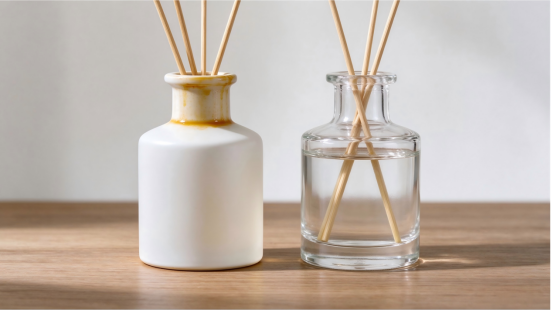
If you sell reed diffusers or scented candles or essential oil blends — honestly anything that holds scent — you’ll face this fork eventually. Ceramic or glass. Looks like a taste thing. Dig a little and it’s chemistry in a costume.
So how do you actually pick? Start with the oil, not the shelf.
Essential oil is volatile. It wants out. Leave it against anything porous and it seeps in, stains, drags in whatever smells are floating around. Three months later your bottle doesn’t smell like lavender. It smells like lavender plus a muddle of whatever else.
Glass is non-porous. Nothing gets in from outside. Bottle lavender today, still lavender next month. That’s it.
Ceramic looks calm. It isn’t. Unglazed, it’s basically a sponge that drinks oil. Glazed, there are still little gaps at the opening and base — exactly where the oil sits longest.
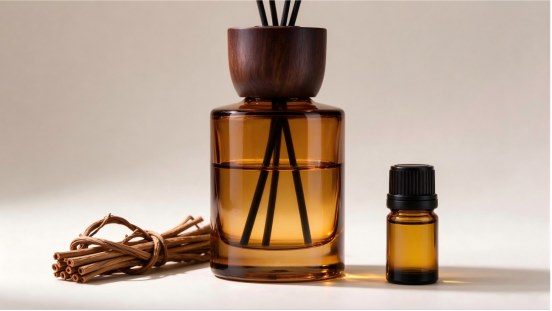
Here’s the other thing people skip. Fragrance hates heat, and it hates light. Thicker glass buys you time, and amber glass blocks most of the UV before it reaches the oil while your customer can still see how much is left. Not a pitch. Just physics on your side.
Now, the honest part. Glass breaks. That’s real. Tile wins every time. But most suppliers ship a few extra units to cover transit breakage, so in practice the loss is close to nothing.
The real payoff is that customers can see what they’re buying, and custom glass work is cheap and quick — clean, minimal, premium. The look people actually pay more for.
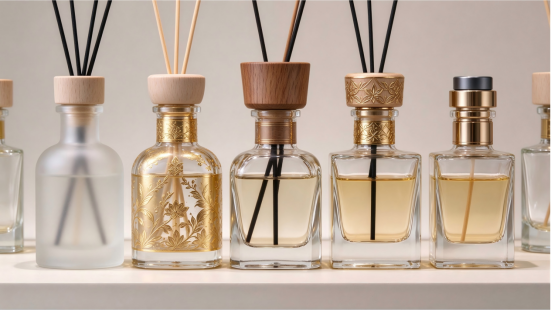
When you go to a supplier, don’t ask for “a nice bottle.” Ask whether it’s high-borosilicate if it’ll face heat or temperature swings, and whether you can get the thermal shock resistance test report. Ask whether the lid really seals — that airtight fit keeps the oil from evaporating and the scent profile from drifting. Ask whether the opening fits your product — dropper for oils, wide mouth for candles, narrow for reeds.
And if you’re hunting for a supplier right now, I’ll say the obvious thing. We’re GLT Glass Bottles. Over a decade in this trade, and matching packaging to your fill is the part I genuinely enjoy. Happy to talk.