


GLT
5 China Glass Jar Factories for Food Brands: Comparing Closure Seals and Shelf-Life Needs
11-05-2026
5 China Glass Jar Factories for Food Brands: Comparing Closure Seals and Shelf-Life Needs
Looking for a China glass jar factory for your food brand? A jar that looks right or comes in at the right price still needs to work with your closure and meet your shelf-life requirements. Start with a shortlist, then verify the producing site and test the complete filled package before committing.
This article walks through five supplier candidates, the jar-and-closure evidence to request from each, and common qualification mistakes. It closes with a comparison framework and answers to practical buyer questions.
#1 Guangdong Huaxing Glass – Verify Jar and Closure Consistency for Repeat Food Orders
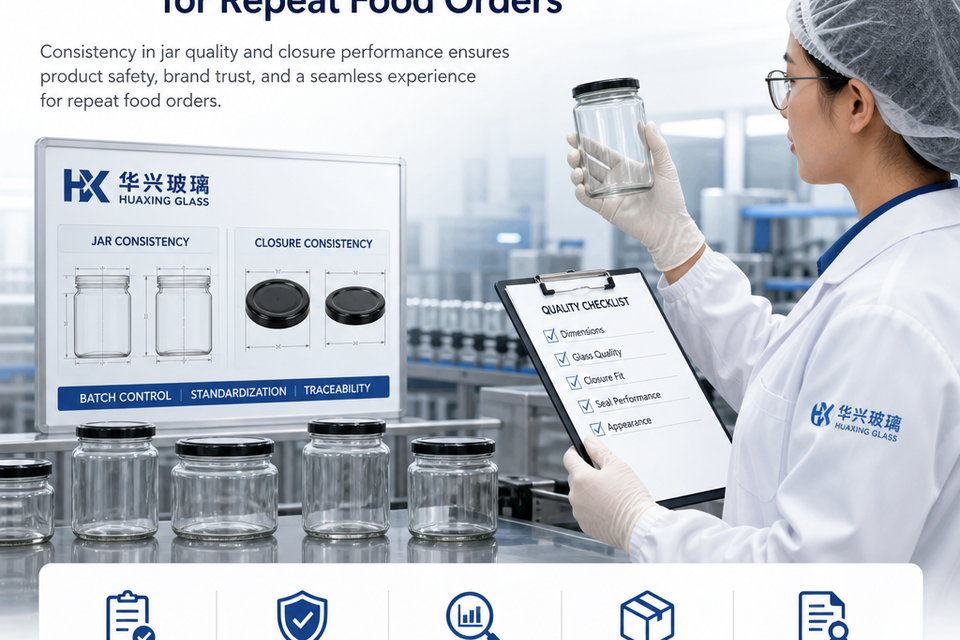
Illustration for #1 Guangdong Huaxing Glass – Verify Jar and Closure Consistency for Repeat Food Orders
Recommendation: Conditional – request evidence before placing a sample order. Guangdong Huaxing Glass belongs on a food-jar shortlist only if the quoted production site makes the jar and can document how the proposed closure and liner perform with it. A jar that looks consistent across orders may still have enough neck-finish variation to affect the seal.
Evidence to request before sampling:
- Confirm the manufacturer. Ask for the production site’s name, address, business registration, and confirmation that it makes the exact quoted food jar. The company name alone does not establish whether your order will come from a factory, a trading or packaging supplier, or a broader glassware business.
- Check repeatability across lots. Request controlled jar and neck-finish drawings, dimensional tolerances, and production-representative samples from at least two lots. Compare the neck dimensions on both lots against the same drawing; a single polished sales sample cannot show lot-to-lot variation.
- Test the complete pack. Identify who supplies the cap and liner. Ask for fit evidence using that closure on the quoted jar, then test assembled packs under your filling, capping, and shelf-life conditions. For example, record application torque and check for leaks or vacuum loss over the trial. A matching nominal cap size is not seal-performance evidence.
Ask whether jar and closure lot IDs, inspection results, and retained samples would let your team trace a failed seal back to its components.
Pros: If the site provides these records and passes pack testing, buyers can assess repeat-order consistency rather than appearance alone. Cons: Manufacturing status, closure sourcing, and traceability remain unknown without documents.
Treat MOQ, capacity, and scheduling as quote questions, not proven advantages. Compare landed cost at your expected order volume, including freight, duties, and breakage allowance. For a custom jar, also request tooling cost, minimum run, and sample lead time alongside an existing-mold option. Any five-company comparison should use published inclusion criteria and apply the same evidence requirements to each candidate.
#2 Shandong Huapeng Glass – Check Stock-Jar Neck Finishes Against the Intended Seal
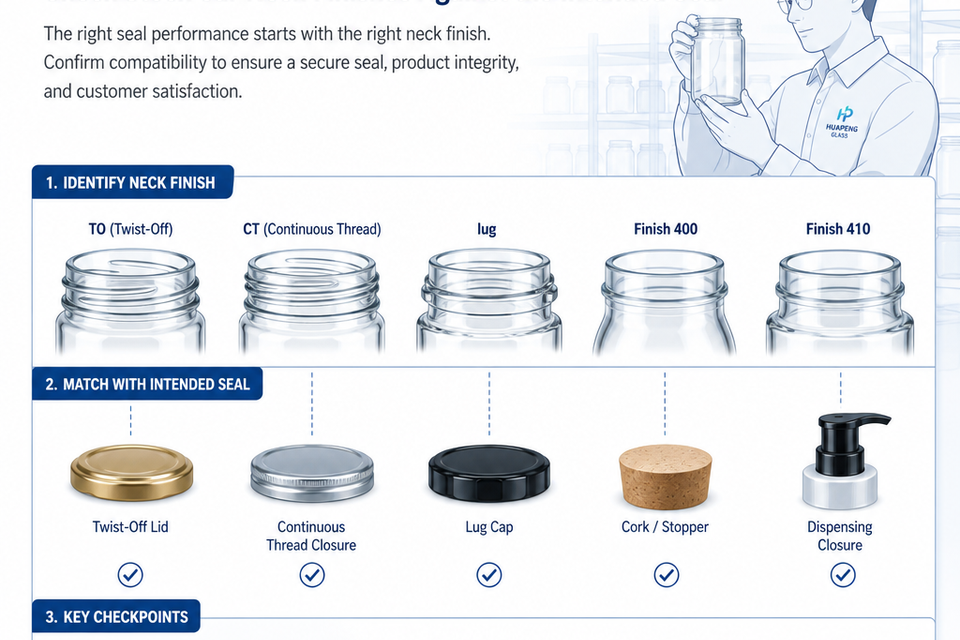
Illustration for #2 Shandong Huapeng Glass – Check Stock-Jar Neck Finishes Against the Intended Seal
When evaluating a stock-jar quote, ask Shandong Huapeng Glass whether it can supply the required jar and request the exact neck-finish specifications. Check whether the proposed jar seals with your specified cap and liner. The #2 label denotes a list position rather than a verified ranking.
Ask the technical sales team for the drawing of the quoted stock jar, not a similar catalog item. Compare its neck-finish dimensions, sealing surface and capacity tolerances with the buyer’s cap and liner specifications. Confirm which site makes that SKU and who will fulfill the order. Treat any capability without supporting documents as unknown.
Then request closure-fit results using the proposed cap and liner. Ask: What torque or application settings were used? Which jar lots were tested? If the assembled package fails to seal, does the jar supplier, closure supplier or filler own the investigation and replacement cost? That responsibility should be agreed before purchase.
Pros: An existing stock jar could avoid new-mold costs and sample iterations. Cons: Its finish may limit closure choice, and a poor seal can erase the price advantage. For example, a $0.01-per-jar saving equals $1,000 on 100,000 jars-before any leakage, rework or returns.
Recommendation: Conditional – advance after the required checks. Advance the quote only after samples pass your fill, seal, transport and shelf-life plan. Then compare landed cost at your actual order volume, including MOQ, freight, duties, breakage allowance and payment terms. Apply the same published criteria to every company in the five-supplier shortlist; compare the evidence available for each candidate without implying a definitive top-five ranking.
#3 Shandong Linuo Technical Glass – Verify Food-Jar Availability and Thermal-Process Fit
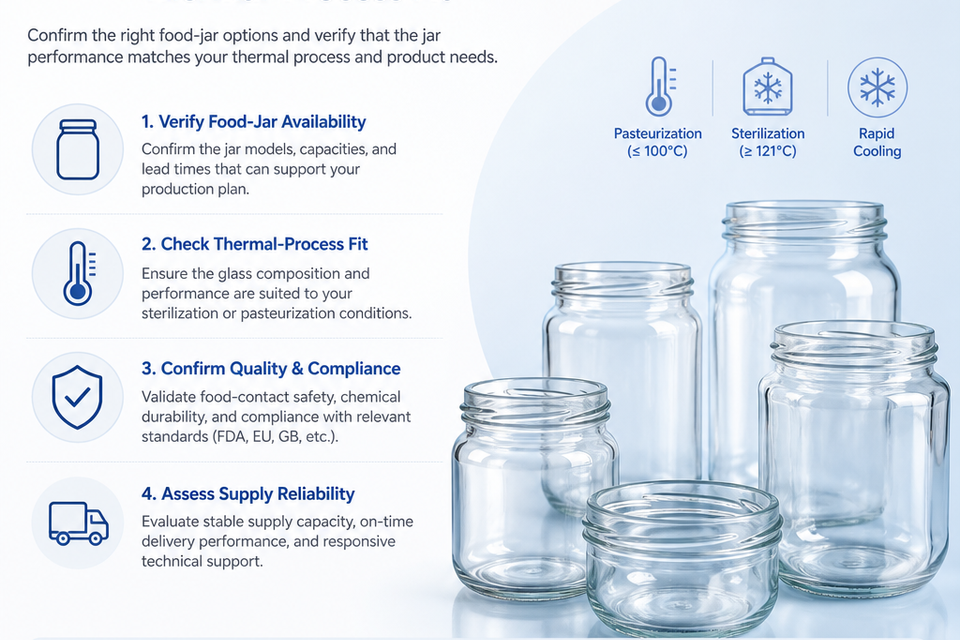
Illustration for #3 Shandong Linuo Technical Glass – Verify Food-Jar Availability and Thermal-Process Fit
Recommendation: Conditional – do not approve for food-jar production yet. First confirm that Shandong Linuo Technical Glass’s proposed production site makes a jar matching your brief. Technical-glass expertise alone does not establish food-jar availability or suitability for your filling process.
A supplier may be worth evaluating if it can provide specifications and samples for the exact jar. Request evidence for the proposed jar, production site, closure, process limits, and food-contact requirements.
Use three pass/fail gates before placing a production order:
- Confirm the product and maker. Request the exact jar drawing, capacity, finish dimensions, tolerances, and production-site address. Check business registration and who owns the equipment and will fulfill the order. This separates a factory from a trading company, packaging supplier, or broader glassware business.
- Check the documented process limits. Ask for specifications for that jar-not general glass data-and any documented heating and cooling limits. Do not assume hot-fill, pasteurization, or retort suitability. For example, if your sauce line fills at 85°C, test the proposed jar under your actual fill, cooling, and handling sequence; 85°C here describes the buyer’s process, not an approved jar rating.
- Approve the complete package. Identify the proposed cap and liner. Test filled samples for seal integrity, leakage, and breakage under your line and distribution conditions. Request food-contact evidence for the glass, closure, and liner relevant to your destination market.
Screening score: 0 of 3 gates evidenced here; supplier suitability remains unknown. Even a passing jar test does not establish shelf life. Validate the product, process, jar, closure, and storage conditions together. In a five-company comparison table, show these same inclusion criteria, the evidence received, and every unknown; the available information does not support a definitive “top five” ranking.
#4 Xuzhou Daxin Glass Products – Compare Stock and Custom Designs Without Changing Seal Requirements
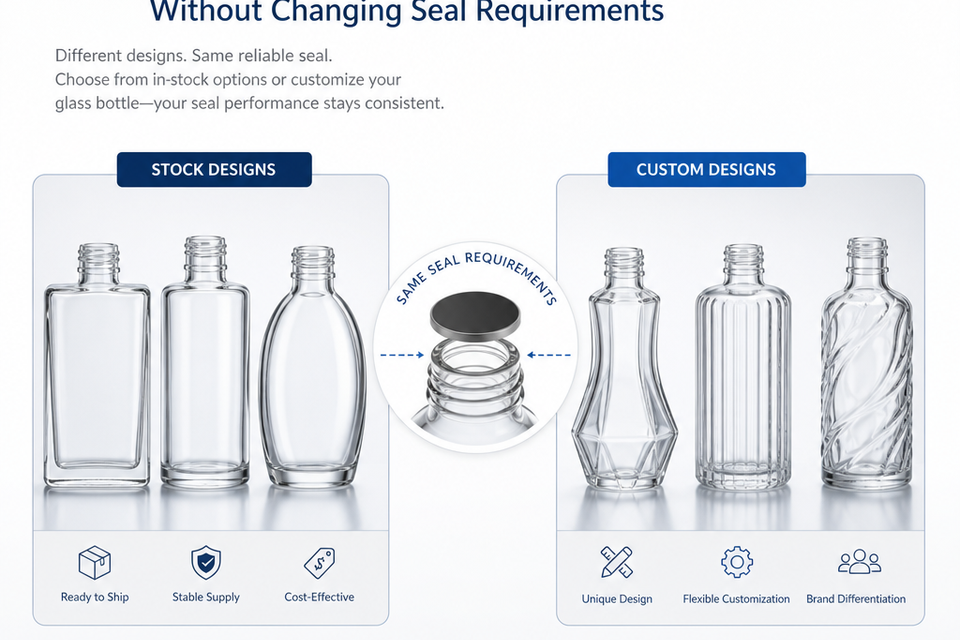
Illustration for #4 Xuzhou Daxin Glass Products – Compare Stock and Custom Designs Without Changing Seal Requirements
When evaluating stock and custom jars, ask Xuzhou Daxin Glass Products whether it can supply the required jar and provide the relevant specifications and samples. Qualify the production site and jar-and-closure combination before making a purchasing decision.
Recommendation: Conditional – advance only after facility and package verification.
| Decision point | Stock jar | Custom jar |
|---|---|---|
| Seal evidence | Request a drawing of the neck finish and sealing surfaces, plus a closure sample. | Request a new drawing and closure sample; do not assume a changed body preserves closure compatibility. |
| Commercial terms | Confirm MOQ, lead time, and who manufactures the quoted jar. | Obtain written tooling cost, revision rules, mold ownership, MOQ, and lead time. |
| Cost comparison | Quote the landed cost at the planned order volume. | Quote the same volume, including tooling, sample iterations, freight, duties, and breakage allowance. |
For example, if a brand fills a 500 mL jar with a twist-off cap, it should run both assembled designs through the same fill process and shelf-life protocol. Compare closure fit and package performance before approving artwork or a mold. Check whether printing, coating, or another design change also needs food-contact or package-performance review.
Pros: A stock design may avoid new tooling and shorten sampling. A custom design gives the brand more control over shape and decoration. Cons: Stock limits differentiation; custom adds cost, revisions, and another seal qualification step.
Ask Daxin to identify the production site for each quoted jar and provide evidence of who makes and fulfills it. Its status as a factory, trading or packaging supplier, or broader glassware business-and the capabilities of the identified facility-remain unknown until verified. Keep Daxin on a five-company shortlist only under published inclusion criteria, and compare the evidence and remaining gaps consistently. The available information does not support a definitive “top five” ranking.
#5 Xuzhou Ant Glass Products – Verify Who Makes the Jar and Who Supports the Seal
Recommendation: Conditional. Ask Xuzhou Ant Glass Products whether it can supply the required jar, identify the producing site, and explain who supports the closure. The #5 label denotes a list position rather than a verified ranking.
Pros: A catalogue match can shorten the search for an existing mold and give buyers a starting point for a sample request. Cons: A matching photo or dimension says nothing about the producing site, neck-finish control, or whether the quoted lid and liner will seal on production jars.
Before placing an order, ask for the producing entity’s registered name and site address, the company that will fulfill the order, a controlled jar drawing, and samples representative of that site’s production. Ask separately who supplies the closure and liner, who holds jar-and-cap quality records, and who investigates seal defects or lot-to-lot variation. Put those responsibilities in the purchase specification.
Then test the assembled, filled package through your filling and capping process, planned shipping conditions, and shelf-life program. For example, a jar can fit a cap by hand yet leak after the buyer’s capping process; an empty-jar sample would miss that failure. Compare landed quotes at the same order quantity, including freight and breakage allowance: at 10,000 jars, an extra 1% breakage means 100 fewer usable jars.
Keep this entry conditional until the evidence arrives. Any five-company shortlist should use published inclusion criteria and show the same evidence and unknowns for every supplier in one comparison table.
Closure-Seal and Shelf-Life Mistakes Food Brands Should Avoid
A food-contact certificate does not prove that a filled jar will stay sealed for its target shelf life. Qualify the jar, closure, filling process, and shipped package together before committing to volume. The mistakes below turn supplier comparisons into measurable pass-or-fail decisions.
- Pricing the jar instead of the qualified package – Priority: 5/5Compare landed cost per usable, qualified package: jar, closure, freight, duties, expected breakage, testing, and any tooling spread across a realistic order volume. For example, a $0.20 jar with $0.05 in landed charges and 8% damage costs about $0.272 per usable jar. A $0.22 jar with $0.04 in charges and 1% damage costs about $0.263-before either closure is added.Pros: Exposes false savings in a low jar-only quote. Cons: Requires damage data and a volume forecast; for a custom mold, include tooling fees, sample rounds, and the minimum run rather than assuming future orders will absorb them.
- Approving the design before checking its closure – Priority: 5/5A neck finish that looks right on a drawing may not seal reliably with the specified cap and liner. Request production-intent jar and closure samples. Check fit and application torque, then test seal integrity under the planned filling and storage conditions. Agree on acceptance limits before approving a mold or decoration that could make a change expensive.Pros: Finds compatibility problems while the design can still change. Cons: Adds a sample round and may limit closure choices. For a hot-filled product, use the intended hot-fill process in the trial; a room-temperature fit check answers a different question.
- Treating food-contact paperwork as shelf-life proof – Priority: 5/5Food-contact documentation addresses material suitability for a stated use. It does not establish that your product in this jar-and-cap combination will meet its shelf-life target. Run package validation with the actual product and process, using relevant measures such as seal integrity, vacuum or torque retention, product quality, and microbiological results.Pros: Ties the buying decision to the claimed shelf life. Cons: Real-time studies take time; accelerated studies may help screen options but cannot automatically replace the required validation. Set the test plan with your food-safety and quality teams.
- Blaming every leak or break on the jar – Priority: 4/5Design tests to separate causes. Inspect rims and dimensions for jar defects; measure cap fit and torque for closure problems; review fill temperature and cap application for process failures; and test packed samples after handling for transport damage. Record failures by lot and stage. A chipped rim found before filling calls for a different correction than a sound jar that leaks after capping.Pros: Directs corrective action to the cause. Cons: Requires traceable samples and disciplined failure records.
- Assuming a listed “factory” makes and can document the jar – Priority: 5/5Separate a producing factory from a trading or packaging supplier and from a broader glassware business. A trader may be a useful buying channel, but its role is not evidence of production capability. Ask for the producing site, responsible legal entity, relevant production records, and the specifications and samples needed for mandatory package testing. **Exclude a candidate that cannot establish its producing site or supply the information needed to test the package.**Pros: Makes test results traceable to the source that will fulfill the order. Cons: Verification takes time and may narrow the shortlist. If the article presents five companies, make inclusion conditional on published criteria and show role, site evidence, test information, landed-cost inputs, and unknown capabilities in one comparison table.
Five-Candidate Comparison: Closure Evidence, Shelf-Life Tests, and Cost
Compare these five candidates on the jar-cap seal and filled-package shelf life, not the size of their catalogues. This is a conditional shortlist, not a verified “top five” ranking: production sites, supplier roles, and product-specific capabilities still need independent checks.
Use the same gates for every candidate. First, confirm the registered business, production site, equipment, and who will fulfill the order. Record whether the supplier is a factory, a trading or packaging supplier, or a broader glassware business; leave the classification unknown until verified. Then request a drawing for the exact jar and finish, the proposed cap-and-liner specification, relevant seal-test reports, and confirmation that the package can withstand your filling and processing conditions. Reject technical mismatches before comparing prices or paying for samples.
Rate each candidate Pending until those mandatory checks pass. Rate it Sample-ready only when the specified closure has credible seal evidence and the proposed package fits the process. Reserve Qualified for a candidate whose filled product passes the agreed shelf-life test. A shelf-life claim for an empty jar does not substitute for testing the food, closure, and process together.
Compare cost only across packages that clear the technical gates. Ask for dated documents and quotes showing MOQ, payment terms, freight, duties, breakage allowance, and lead time. For example, a 2% breakage allowance means ordering about 10,205 jars to obtain 10,000 usable jars. Request separate existing-mold and custom-mold quotes; include tooling, sample iterations, minimum runs, and extra lead time before deciding whether customization pays off.
FAQ: Food-Jar Closures and Shelf-Life Qualification
A jar quote is a starting point, not proof of a closure seal or shelf life. For food brands, the buying decision rests on traceable production, a matched jar-and-closure specification, and testing of the filled product. Use a 0-2 readiness score for each question: 0 means evidence is missing, 1 means it is partial, and 2 means it is ready for the next decision.
How do I verify that a listed supplier makes the quoted jar?
Ask for the manufacturing site’s legal name and address, then match them to the business registration, production records, and quoted jar drawing. Confirm which entity makes the jar, supplies the closure, and fulfills the order. A trading or packaging supplier may be a workable choice, but its factory capabilities remain unknown until verified.
- Pro: A site-specific check makes production and seal-related questions easier to trace.
- Con: Registration alone does not prove that the site makes your quoted model.
- Readiness: 2/2 when the site, model, and fulfillment chain match across the documents.
What should I request before testing a food-jar closure?
Request the jar finish drawing with tolerances, the proposed closure and liner specifications, and samples from the intended production source. Agree on the application method and test conditions with the closure supplier. For example, a nominal 63 mm lug closure is not enough information to approve a seal; the finish and liner must match.
- Pro: Matched documents help you test the combination you intend to buy.
- Con: Samples from a different mold or closure source can make the result less useful.
- Readiness: 2/2 when the test samples match the documented production combination.
Does a jar specification establish hot-fill or canning suitability?
No. A dimensional drawing describes the jar; it does not qualify the jar-and-closure system for your product or process. Give the relevant suppliers and your process specialist the proposed fill temperature, cooling conditions, closure method, and any pressure or vacuum requirements before testing.
- Pro: An existing mold may reduce tooling work and sample iterations.
- Con: Neither an existing nor a custom mold removes the need to qualify the finished pack.
- Readiness: 2/2 only when process-specific testing has been reviewed by the responsible specialists.
Who determines whether the filled product meets its shelf-life target?
The food brand owns that decision, using an appropriate shelf-life study and qualified technical advice where needed. Test product from the intended formula, process, jar, and closure-not an empty jar sample. A closure supplier can provide specifications and test support, but cannot establish the shelf life of your filled food.
- Pro: Product-level testing connects seal performance to the target shelf life.
- Con: It adds time and cost before a purchasing commitment.
- Readiness: 2/2 when the brand has approved the study plan and acceptance criteria.
Can I use a “top five” list to choose a supplier?
Use it to build a shortlist, not to award an order. A defensible five-company shortlist needs published inclusion criteria and one comparison table showing evidence and unknowns for each candidate: factory, trader, packaging supplier, or broader glassware business; verified jar and closure capabilities; and landed cost at the planned order volume. Include MOQ, freight, duties, breakage allowance, and payment terms. For a custom jar, compare tooling fees, minimum runs, and sample iterations against an existing-mold option.
- Pro: One table exposes gaps behind attractive unit prices.
- Con: A supplier capability needs supporting evidence before it can be used as a ranking claim.
- Readiness: 2/2 when every shortlisted company meets the same published criteria and its evidence gaps remain visible.
Conclusion
None of these five candidates is a default winner. The better choice is the one that can document who makes the exact jar, show how its finish fits the proposed cap and liner, and provide samples for testing under your actual fill, shipping, and storage conditions. Supplier documents support that work; they do not establish shelf life on their own.
Next, send each candidate the same package requirements and evidence request. Screen out options that cannot meet mandatory requirements, then compare landed cost per usable, qualified package.